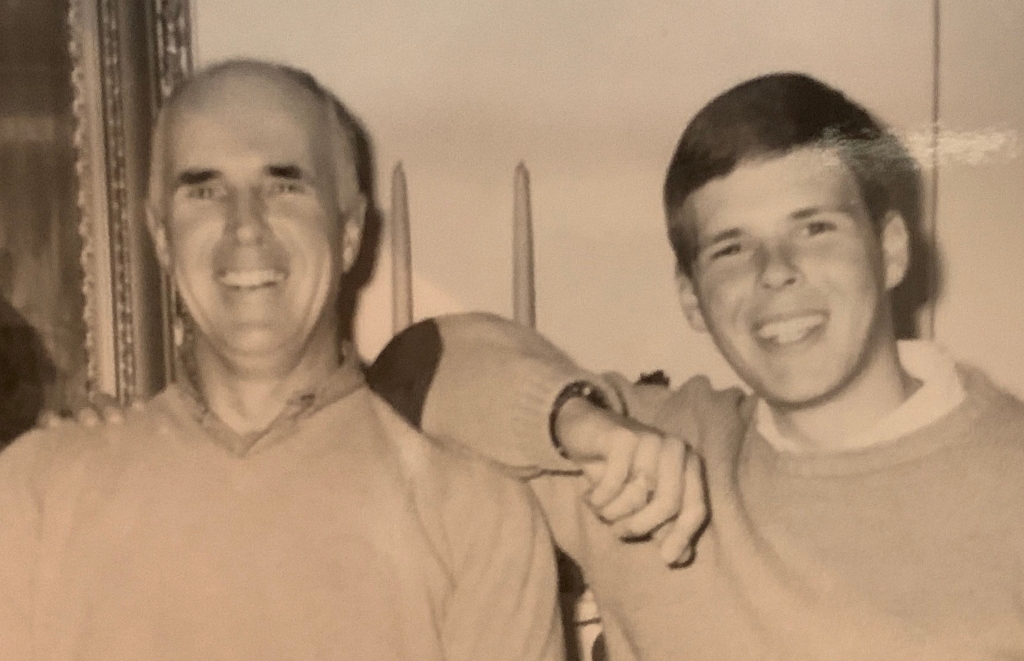
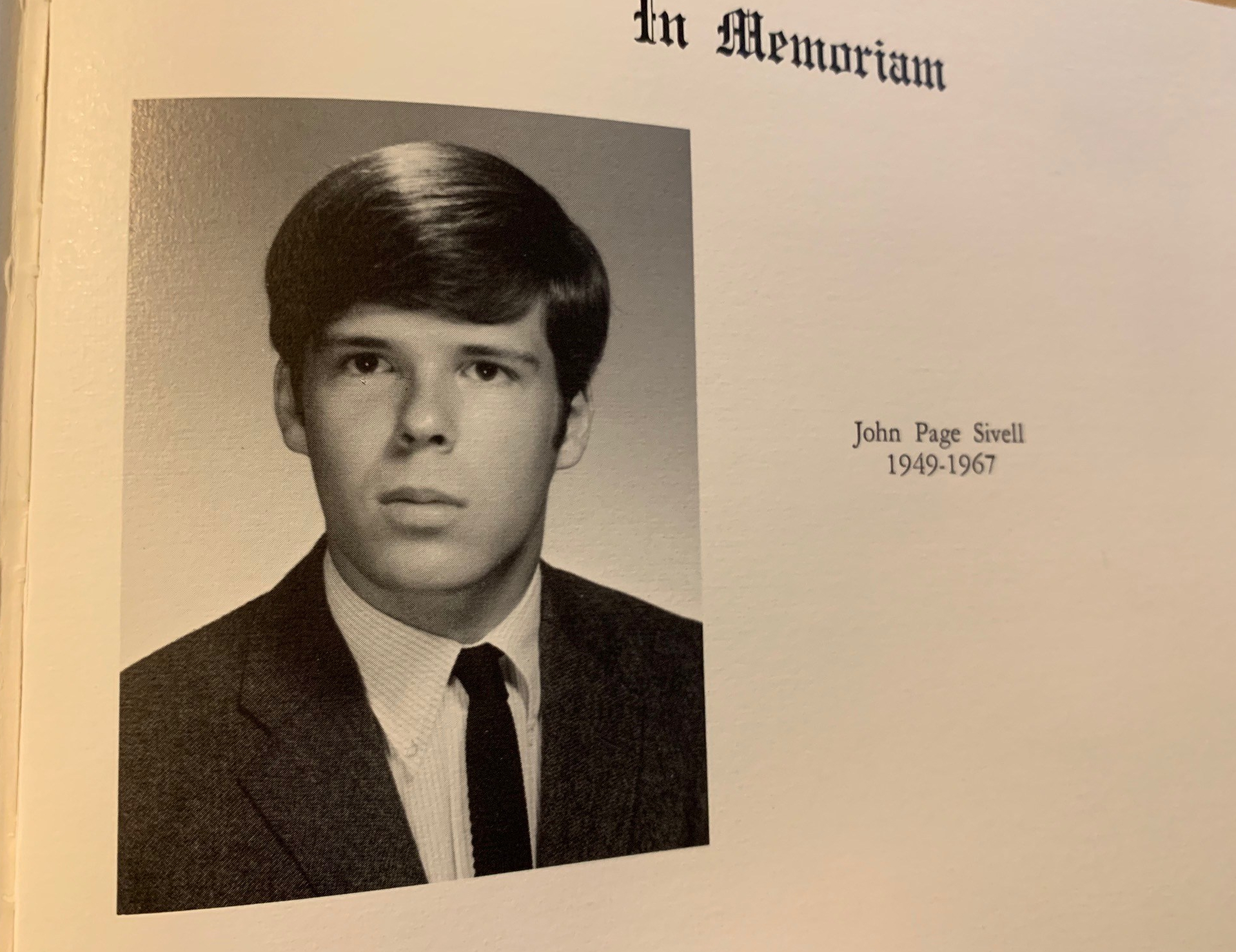
Most of the time Page was out of it. Mom spent all her time at the hospital but Doom had to work. Having a child hovering between life and death didn’t seem to matter to his bosses at the home office in Minnesota.
A few days after I got back from the Vineyard, I headed off to football camp with our high school team. Camp was a week of practices and long runs through the woods. It was operated with a militaristic attitude and we were fueled by food several grades below cafeteria food. We were stuck in the woods, an hour from home, with every minute accounted for. We lived in spartan bunk houses, enduring grinding, two and a half hour practices – one in the morning and another in the afternoon under the August sun.
But this particular year, I didn’t mind going even though I was there with a bunch of seniors I did not like. A few were nice and bright and have gone on to lead educated, non-thug lives, but more than of few of them seem to have led lives that could have been the themes for blues or country music songs.
I hated the Lord of the Flies aspect of football camp. In just a few days, under coach-imposed harsh conditions, some people would turn whatever values they had been taught at home on their heads to survive the upperclassmen who ran the jungle when the coaches weren’t around. But the first two days that year are a blur because on the morning of the third day, the whistle had just blown on a play during practice when I was called to the sidelines by the head coach, told to shower and get up to the kitchen.
I immediately knew why. Even if it hadn’t been such an obvious break in routine, I would have known.
I took my time leaving practice but then Coach Chalmers, the line coach and the coach we feared the most, yelled at me to get going. I left but I didn’t hurry. The longer it took me to get to the kitchen, the longer Page was alive. Once I heard the news, my life would forever be changed. Bennie DeSalvo, who was our new offensive line coach that year and whom I had known before only as the Spanish teacher, was waiting there for me. I could see him as I slowly made my way from the shower room. I kept walking slower and slower. But I kept getting closer to him.
It was inevitable.
He told me in a very kind way that Page had died that morning and that someone was coming to take me home. I heard the words coming out of his mouth but it didn’t seem real. A numbness crept around my scalp and it seemed as if there were a swarm of cicadas buzzing just outside my ears. I tried to take the news matter-of-factly, as if he were telling me that I wasn’t playing well and needed to remember the blocking schemes better.
But my lip began to quiver. I didn’t cry, but just about. Then I latched on to the sight of those 5 or 6 strands of hair on the bridge of Mr. Desalvo’s nose and I just kept staring at them to maintain my composure. And I began an internal dialog that resulted in the pledge to myself to always to be vigilant about my appearance. Even when I got old.
That was a mean thing to think about a man being so kind and caring to me and I began to feel guilty about thinking it. I was just trying not to think about Page.
I tried to reassure Mr. DeSalvo that I was all right and that we had expected this. That was true. By that point, Mom and Doom knew he was going to die – after all he’d been lying in the hospital for three weeks not getting better, not saying anything – and they had begun to prepare me by saying things that indicated that he wasn’t going to make it. They didn’t come right out and say it, but I had known.
“You are never prepared when someone you love dies,” Mr. DeSalvo said. He knew about death. He had been shot down in the war and spent a year in a German prison camp. “No matter how much you try to prepare yourself, you’re never prepared.”
Of course, he was right. And I’ve thought of Mr. DeSalvo and his words a lot over the years. I’ve never been prepared for the deaths of those I’ve loved. Be it Page, Doom, Mom or my friends George and Ernie. I think Mom – who I was closest to – was the easiest because I was there. I was holding her hand as she died and it seemed as if my sister, Liz, who was holding her other hand, and I were guiding her up some steps. I was sad to lose her – although my real mom had been lost several years before to dementia.
Mr. Hudson came to camp and drove me home. The Hudsons, who lived at the end of the block, were a very proper family, rather like the Cleavers come to life. Mr. Hudson was Ward in his physical characteristics and he always seemed to have a tie on, even on weekends. When I got my paper route, the Hudsons asked if I could deliver their paper because they were unhappy with their carrier and even though they weren’t on my route, I did it. I just made up an address on my regular route and got a paper for that house, but dropped it off at the Hudson’s on my way home.
When we got home, I walked in to our house and the windows were all wide open and the rooms seemed bigger. Everything appeared to be back lit and gauzy and I couldn’t really focus on anything. I wandered from room to room and couldn’t find anyone. Then Mrs. Hudson appeared and took one look at me.
“Go upstairs, honey,” she said. “You need a good cry.”
That’s the best advice I’ve ever received.
I hadn’t cried when Page got in the accident. I hadn’t cried on Martha’s Vineyard. I hadn’t cried at football camp. I hadn’t realized it, but I closed my heart and mind so I could deal with the situation. By not facing it, I thought I was able to face it.
I was wrong. I ran up the stairs to the 3rd floor and closed the door to my room and threw myself on my bed and sobbed. Huge sobs that left me gasping for air. And every time I thought I was done, I began crying again, harder.
I cried for my mom and dad when they died some 40 years later, but nothing like I cried for Page. For the first time, I realized what it meant to release feelings. We were not a huggy, talk it out kind of family. We were pretty buttoned-down, holding things in, figuring it out on your own.
I cried for everything about Page. He was such a handsome, charming, smart guy and he just had one little thing in his brain that couldn’t be satisfied and it kept getting him in trouble. I cried because of his lost potential. And I cried because I lost the guy who knew me better than I knew myself. The guy who was supposed to be my life-long friend. We only had 16 years together.
We weren’t best friends at the time of his death, but I admired him for all his positive attributes and he liked mine. He liked my normality and my ability to get along with people – although he did warn me about my smart mouth. I learned from Page that I didn’t always have to be first with the wise crack and sometimes it is better to just keep your mouth shut. Because sometimes when you get noticed, you get knocked down. So pick and choose your moment.
And the “What ifs” started that day and continue still almost daily in my quiet moments. What if seat belts had been mandatory or even commonly used in 1967? What if today’s surgical techniques and equipment had been available then? What if Robby, his passenger who walked away from the accident, had insisted on driving? It was his car and his license.
And if Page had lived, what would have happened to him? He was already drinking heavily. At that stage of his life, he just couldn’t stop himself. Would he have outgrown it? Would he have survived the next 10 years with all the drugs that bathed the youth culture in the late 60s and early 70s? And if he had survived and had continued on that path he was on, would my parents’ relationship have survived the strain? I have replayed his life and his choices over and over for the last 50 years, often substituting a variety of “what ifs” but the end is always the same.
Reality.
Page dies. And we are heartbroken.
When I was about out of tears, Mrs. Hudson came into the room. Unbeknownst to me, she had come upstairs and stood outside while I followed her advice. Then, as the sobs subsided, she had come in to help me collect myself. She sat down and let me talk about Page and she told me about how my parents were doing and what the plans for the week would be.
I remember the day of the funeral, partly because a couple of pictures were taken that have helped me keep it in my head. We used the Ahearn funeral home. They lived up the block and across the street from my friend Danny Austin’s house and, since they had a cute daughter, we spent a lot of time trying to get her attention. Mr. Ahearn took a shine to me for some reason – maybe it was my manners around adults – but he always stopped to say hi and talk to us and he seemed to focus on me. He was very kind at the funeral, which I know is what morticians are supposed to be, but it wasn’t unctuous.
I’d never been to a funeral before so I didn’t know what to expect. Usually the younger the person dies, the larger the funeral because they are in the flower of life and they have lots of friends. But Page was a different cat and he didn’t have a wide circle of friends (and those he did have were not approved of by my parents, with good reason) and the death and funeral happened in August, before we had gone back to school. So the attendance wasn’t especially large. It was mainly adults who had come to support Mom and Doom, knowing how hard it must be to lose a child. Even a child as wild and as troubled as Page.
When people get back to the house after a funeral for a person who has lived a long life, it’s a bit of a celebration. Stories are told about the deceased and families catch up and vow that it won’t be so long next time they see each other (and after a certain age, that is true because people start dying with some regularity). When a young person dies, it’s more somber. There aren’t a lot of stories and there isn’t a lot of laughing.
What stands out about Page’s funeral is that my sister, Carol, came home. Carol hadn’t been gone from the house too long when you look back on it, just 2 years, but we’d been a tight family unit, somewhat insular because we didn’t have large families on either side of the tree and none of them lived near us and it took special trips to go visit them. When Carol left and went off to college, we went to see her on a fairly regular basis that first fall. Doom and I liked going to her school’s football games. But then she met Ed, got married, dropped out of school and had a baby. This didn’t please my parents and I don’t remember what was said, but for about a year there was no contact between us.
Except for Page. He came back from one of his escapades to the shore and told me he had stopped in to see Carol. It was very exciting. He had made contact with the “enemy.” I don’t know how many times he stopped in and saw her but they made a connection that they didn’t always have when we were kids because they were now both outlaws. I can’t remember how many times Carol had to beat him up – you didn’t mess with Carol when we were kids, not even Page – because she didn’t like the way he was picking on Liz or me. But during her time away, they were both rebels.
So when Carol showed up with her little baby girl, Jen, who was just 3 months old, it changed the atmosphere. It was all about the baby and rebirth. There is a great picture of Carol holding Jen out in front of the house with Mom and Liz smiling widely and admiring Jen. I hadn’t thought there would be any smiles in that house for a long time. But Carol’s coming with Jen signaled a shift from grief to getting on with life.
Bethani is also in that picture, sitting in the shadows of the porch, her head resting in her hands, taking it all in. It’s a poorly developed photo that is creased and has been fading a bit each year. It’s one of the few pictures I have of her and I long wondered what she was thinking that day, a teen-ager thrown into the maelstrom of another family’s deepest grief.
40 years later I found out. 40 years later I got a clear picture of what others saw that day.

We were cleaning the house out after my mother died in 2007 and in her dresser next to her bed was a book she had been reading, before her dementia put an end to that. We thought at first it was a cherished book, to be inside the dresser and not on top of it. But it wasn’t the book that was cherished. It was the bookmark: two neatly folded sheets of paper, featuring a poem Bethani had written after the funeral. At the top of the page she wrote: “For Alan.”
What I Saw
The screen door banged shut
And shook the wisteria
That held the porch to the old stucco house.
Opening an eye,
I threw back my head
To see blue patches flash
Among the mass of green and gold
That rustled high overhead.
Swinging my feet off the banister
Onto the smooth, cool planks;
I dragged the chair to the sunny spot
Where I could peer in through the screen.
What I saw
Was the same comfy living room,
With furniture a little too worn
To give it that special occasion look.
But on that day
Every flower in the world
Seemed to have found her in that room,
Like the little boy in Paris
And the red balloon.
One by one
She opens a pile of envelopes,
Giving each a moment of quiet concentration.
And after awhile
She lit a cigarette,
With the same deliberate calm
That controlled every line of her body.
A swirl of smoke slowly veiled
Her dress of simple black.
And there was grace
In the simple lines of her face,
And the age she had gained in one day.
Company came
And walked quietly across the living room rug.
Her husband stood by her side
As she took each caller by the hand;
Talking in an even tone
And laughing gently now and then.
Her husband watched her,
And when she caught his eye,
They shared an instant of despair…
A lifetime of courage.
She stood and went into the dining room:
The company filed in behind her.
The screen door banged shut
And he dragged a chair
Up to a spot in the sun.
And he said the things his mother could not.
I think that I understand…
I think I may never understand
What I saw.
Next week: Chapter 14. Living Isn’t Easy.
Categories: My story

 Alan Sivell's A Boomer Life