
I had said I wasn’t going to be Page’s bagman ever again. But about a year after the Hard Roll Heist, there was one other escapade that he managed to entangle me in. The two of us were hanging out talking and playing records on the third floor one Sunday after the obligatory hour and a half of church.
If I had been thinking and not simply enjoying myself, I would have known that what we were doing was not exciting enough and that could only spell trouble eventually. Since we weren’t doing anything special, at least nothing that was giving Page an adrenaline rush, he suggested we go up to the Center.

Page wasn’t a guy to hang around the Center and socialize, whereas, that was my main thing in junior high days. You went to the Center and walked around and ran into other groups of guys and girls who were at the Center walking around. You always hoped the girl you liked was there at the same time, walking with her friends. And you hoped she had the same number of friends as you did so you could pair up for a bit, and maybe grab an ice cream at the Farm Shop or Lincoln Dairy or go to the record store and look at the albums. A date before you were old enough to date.
Still, I agreed with Page’s suggestion because even though it was Sunday and there was always the volatility of Page to consider and none of the stores would be open, the ice cream shops would be and there was a chance, however small, that we would see somebody we knew.
So we began walking the mile to the Center. We were almost there when he said we should check out the cars at Grody Chevrolet. It was just a block off Farmington Avenue and one block short of the Center, so we walked over there and were looking at the cars. Then Page revealed his real purpose for hanging out with me that day.
“Let’s take one of these cars for a test drive.”
“What?”
Page had discovered that the guys who ran the used car lot left the keys in the cars. Rather than have them in the building and run back and forth trying to grab the right key for the customer, they just left them in the car under the driver’s side floor mat. This was 1964, but even then I remember thinking that it was a pretty dumb place to put the keys. Page found a car he liked, jumped in and started it.
“Get in,” he shouted.
“Are you nuts?” I couldn’t believe him. “Are you completely insane?”
“Get in, you chicken,” he said. “It’ll be fine. I’ve done this a million times. Just get in.”
Reluctantly, I did and we took off.
We didn’t go far.
“I told you we were going to the Center,” Page laughed, as we drove through the center of town.
I was too nervous to enjoy the ride while Page was having a great time, a wide grin plastered on his face. I don’t know if it was the thrill of taking the car or the panic he saw in me. We went around the Center enough times to realize nobody was there and probably wouldn’t be. The thrill of taking the car and terrorizing me began to wear off so he headed back to the dealership. As Page maneuvered to get the car back into the tight spot that he had taken it from, we weren’t paying attention to our surroundings.
Now another great reason for not taking cars from that particular lot – besides the obvious one – is that the police station was right next door. When we got out of the car and began walking away, we spied a cop across the lot. He had just come out of the station house and begun walking his beat. We couldn’t tell if he’d seen us pull in.
“Act real casual,” Page said out of the side of his mouth. He wasn’t looking at me. “Let’s slowly make our way toward the Center.”
The two of us should have been able to out maneuver a single cop in a big parking lot, but he played us like a chess master playing Central Park amateurs. We couldn’t run and reveal our guilt, and somehow he kept getting closer and closer to us until he was just on the other side of the car we were pretending to look at.
“That your car?” he asked, pointing back to the car we had just parked.
“Yeah,” Page replied.
We began walking again, away from the car, heading toward the Center. We were at the edge of the parking lot, just about free.
“Wait a second, guys,” the cop said. He was standing right behind us. “Don’t forget your car.”
Page put on a big grin that said he knew exactly what he was doing, but thanks for reminding him. “Oh, we’re going to leave it here while we go to Bess Eaton for donuts and coffee,” he explained.
Which was a stupid thing to say because the donut shop was in the heart of the Center, about three blocks away. Parking might be tight on a Saturday, but there would be plenty of parking on a Sunday. No one would park his car three blocks away on a Sunday. And unless he was selling it, no one would park his car in a car lot on any day.
“You should take your car,” the cop said. “No need to leave it here today.”
“Nah, “ Page stalled. “We’re going to come back and look at more cars.”
They went back and forth until Page’s declarations got more absurd and the cop, while enjoying the queen vs. pawn game he was playing, finally let us know he knew the car wasn’t ours.
He asked Page for his license and registration and he didn’t have either. So he grabbed the two of us and walked us over to the station. We sat there for what seemed like hours. I learned about the big clock that every kid who has been in trouble at school or with the police learns about. The clock moves very, very slowly. And it gets stuck for minutes at a time and then all of a sudden it leaps forward a few minutes.
They separated the two of us. I figured it was so we wouldn’t try to get our story straight. But there was no story to get straight.
Page had been “borrowing” cars for some time and they wanted to get some information out of him. That was part of Page’s problem. He would commit a crime of opportunity, see that it worked and figure it could work again and again. What he could never imagine – because he couldn’t see them – was that people might be upset about having their rolls, cars or valuables stolen and they set traps. And because he didn’t know when to quit, Page fell into the trap every time.
Mom and Doom were pretty disappointed in me. It was hard enough on them to have Page break every rule. They didn’t need two of us breaking rules. I don’t remember getting punished but I do remember them telling me not to hang around with Page.
Most families like it if the kids are friends. But we were at a turning point and my parents knew it. In fact, as Page’s reputation began to grow, he stopped having any friends in school. He acquired several acolytes from the rougher section of town, guys who liked to do the antisocial things he liked to do. Parents would tell their kids not to hang around with him and my friends’ parents would tell their children not to be at my house if Page was there and no parents were home. He was like a loaded gun.
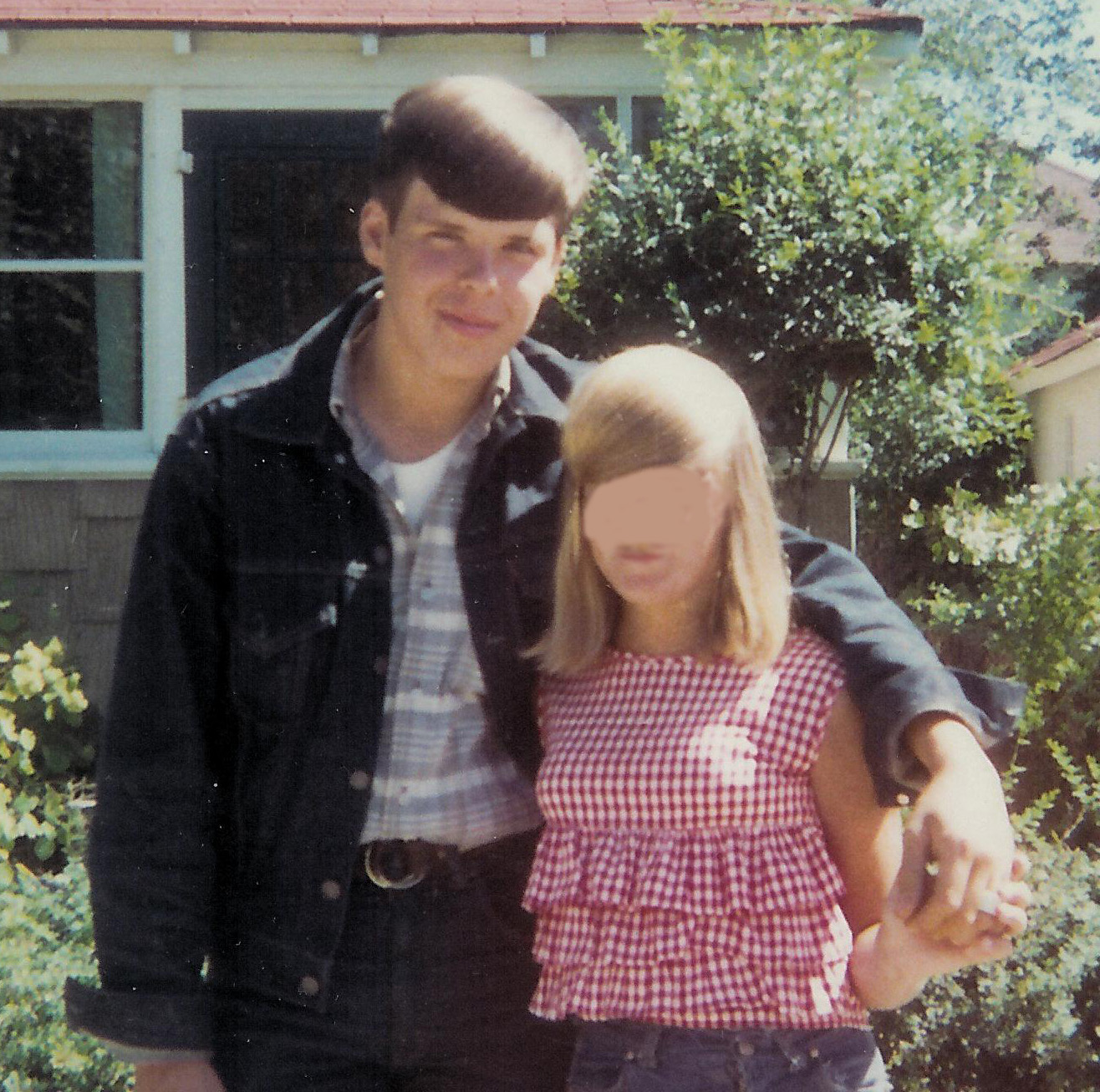
The next summer, he was nabbed for stealing a car down at the beach. By this time, he was 16. Before, it had been childish pranks that could be punished by being hauled down to the station and placed in front of the big clock for hours. Now, he was getting older and the problems and escapades were escalating. This particular time, he was dating a 14-year-old girl he would wax poetic about. He painted a picture of a teen-age Marilyn Monroe in my mind. I never saw a picture of her until many years later, going through a box of his stuff.
She looked like a gawky, non-descript 14-year-old. And I am not being unkind. I wouldn’t have picked her out of a crowd of two. She had long, straight, dirty blond hair that appeared to be her main feature. Bangs hide most of her face. Her lips are pursed and she is squinting slightly in the sun. Her face is plain and she almost appears surprised to be in the arms of this big, older man-child. Even though they are at the beach and she is in shorts, Page has jeans and a jean jacket on. He always wore the jacket when he went out “just in case,” he explained, “I spill any battery acid on myself.”
Her living at the beach made it a challenge for Page. Since he had been in trouble, he hadn’t gotten his license when he turned 16 and had no car. He thought it perfectly acceptable to hitchhike down there to see her, but once he got there, he felt he needed to drive her around. So he’d steal a car. But this particular time, he stole a car that needed gas. Conveniently for him, there was a set of very nice golf clubs in the trunk. So Page sold the clubs – a set worth $300 in 1966 – for 10 bucks and they went joy riding.
Page got caught because he often didn’t think very far in advance. He stole the car from a neighbor of the girl and they nabbed them went he tried to sneak the car back. Mom and Doom got the charges dropped because they agreed to make restitution. That arrest made the papers and it must have killed my father to pay for golf clubs that he couldn’t use or afford.
And it was that type of crime that got Page sent to reform school. By now the cops were well aware of him. It’s not like he was robbing banks or doing anything too violent other than those fights at the dances. But he was not adjusting his behavior.
Around Christmas that same year, he went to visit a girl he liked who was baby-sitting. Apparently, she didn’t want to do what he wanted to do and she pretended to fall asleep after she had put the kids to bed. Page figured that if he wasn’t going to get what he came for, he might as well get something. So he grabbed a bunch of stuff and cash from the house and took off. Yes, he robbed the house his girl friend was babysitting at. His test scores and aptitudes tests always showed he was very smart. But he could really be stupid.
At the time, I didn’t know any of this. All I knew, he suddenly had money and a bunch of new toys, such as a cool portable reel to reel tape recorder, with which we had a great time recording ourselves. In those days, we just didn’t have as much and you noted every new thing a kid had. Yeah, I wondered about the tape recorder, but Page was always “finding” things so I didn’t question it too deeply. I didn’t want to. Later I realized that Page was “finding” things in people’s cars, houses, lockers, etc. such as the cordless shaver he had given me two months after my birthday.
We played with the tape recorder for a few days, performing plays with funny voices and laughing ourselves silly. That laughter would soon end.
A few nights later, after dinner, there was a knock at the door. I remember thinking immediately that it was odd. We were a family that came in for dinner and then didn’t usually go back out except in the summer. We had to do our homework. I remember being so jealous of my friends who could go back out, who didn’t eat every night at 6 o’clock. But I did like the regimentation of knowing when things were going to happen, when we were going to eat.
I went to the door and there were two men in suits who looked to be in their 30s and they asked to see Mom and Doom. Liz and I were sent to our rooms, which turned out good for me since my room was on the third floor, across the hall from where they wanted to go.
They were West Hartford detectives and they had a report that some items had been stolen from a house and the baby sitter had said Page had been there. They had a list of the stolen items, one of them being a tape recorder. I could hear the cops, Doom and Page talking in his room and Page was saying he didn’t know what they were talking about. Well, they found the tape recorder in short order and Page denied that he had ever seen that before.
He was acting childishly, denying evidence that was in plain sight, but he was still a few months shy of his 17th birthday. Then they pushed the button to play the tape and you could hear Page and me on the tape. That was all the cops needed. They took Page away that night and he didn’t come back for nearly a year.
He was sentenced to a year in juvenile detention. Mom and Doom used to drive down to Cheshire Reformatory to see him but Liz and I couldn’t go. He was allowed to have a radio, but it couldn’t have speakers so they took a nice Emerson table radio that we used to listen to Yankee games on to a repair shop and removed the speaker and attached headphones so Page could listen without disturbing the other inmates.
Mom and Doom drove there religiously every week, even during golfing season. Usually it was for an hour visit, sometimes longer if it was allowed. It must have killed them. But Page’s punishment was really needed. He had been totally out of control. He had grown into an adult body, even if he had an immature brain.
Doom had gotten to the end of the rope with him and just couldn’t control him with reason or punishment. So he tried fighting him. Doom had been an all star football player in college, but now he was almost 50.
I remember one night when Doom tried to keep Page home by blocking his exit. The two of them began bashing each other on the 2nd floor in the narrow hallway with a rickety banister that kept those on the second floor from the first. The fight was fast and furious, mostly two big bodies pushing and shoving, with a couple of quick swipes to the head to gain control.
The wooden banister bent and stretched unnaturally, making sounds like old bones about to snap. Mom was at one end of the fight screaming, sobbing for them to stop. I was at the other end watching, not believing something like this was happening in our family.
We seemed so normal. Well, except for Page.

After that, when Doom tried to confine him to keep the damage he did to society to a minimum, Page would sneak out of the house. He would go out the window on the third floor, drop down to the roof of the back porch on the second floor and then drop to the ground.
One night he was about to drop down and Doom, who was hiding in the back yard, turned a spotlight on him. Doom thought Page would realize he’d been caught and scramble back into the house. But when Page made up his mind to do something, he couldn’t be stopped. So he climbed up over the roof of the house – this was a full 3-story house – and dropped down on the front porch, then to the ground and beat it before Doom could get around the house.
Years later, when the hurt of those years had faded, Doom told that story with some measure of respect for Page’s athletic prowess.
Going away really did Page some good. Doom thought so too, noticing a change in his behavior while he was gone. So Doom went to court to ask a judge if Page could get out early to be at school when it started in September with the stipulation that he play football. Doom thought the team spirit and discipline would do him good.
But the judge said no and Page didn’t come home until mid-October. He got a job at Lincoln Dairy – a sandwich and ice cream parlor, went to school most days and wasn’t completely out of control. Yes, he was still pretty wild, still getting high – although not as often – and still was getting in fights.
One night a couple of months after his return, there was a big party at Karen Viola’s house. There was a big party at Karen’s house every weekend, as her parents played in the symphony and they were gone both nights of the weekend and sometimes traveled.
The house would be crawling with kids and more kids showed up each weekend. There would be crowds of kids in the living room and the kitchen and couples tucked into every dark corner in the house. By the time my brother got wind of it, it wasn’t just kids my age – freshman and sophomores. The juniors and seniors started showing up. As did kids from the other side of town.
It was at a party just before Christmas – Page had been home about two months – when I heard a scuffle in the kitchen. That was nothing new as we had a lot of high schoolers getting drunk for the first time. Fights often were part of the party. But the voices kept getting louder and louder and then they quickly faded as they must have moved outside.
I was curious, but I was in a dark corner of the living room with a girl and I was trying to decide whether to make out with her. I liked her, but not in a way that would last beyond that night. Just for the fun of making out. I was weighing the penalties: I would have to be her boy friend for a few weeks, call her on the phone a few nights a week and make small talk for a few hours. Then I would start to ignore her or just avoid her altogether and then there would be a scene and I would have to tell her it’s not you, it’s me. And there would be crying.
I never for a moment considered that she might be on the same wavelength as me and just want to have fun that night. Because it didn’t usually work that way in those days. A kiss came with lots of attachments. I didn’t want to even think about going further than a kiss. That could mean years or a lifetime of commitment.
All this was going through my head when the cry of “Fight!” was more temptation than the girl I was with and I ran to the now almost empty kitchen and someone said Page was involved. The house was packed with so many kids, I didn’t even realize he had been there. But like a moth to the flame, he came where the action was. I grabbed my coat and ran outside. The fight was over and people were scattering.
“What’s going on?”
“Page stabbed Jonny B!”
“Stabbed him?”
“Get outta here before the cops get here!”
Oh, no, I thought. Now he is going back to Cheshire. Or worse. I was about 3 miles from home and in the middle of a party and the middle of a debate about the merits of a make out session. But I just took off running for home. I made it up to the third floor and waited and worried.
About an hour later Page showed up. He had headed for home right after the fight, too, but he had snuck between houses and hid from cars the whole way. He kept seeing cop cars, sure they were after him. We stayed up all night and waited for the knock on the door. Page kept talking and I kept worrying. Finally we fell asleep. Sunday came and went and no cops.
Monday we went to school and there, coming down the hall was Jonny B. He was fine. Apparently, the knife Page was using was an ordinary kid’s pocket knife, which can do a lot of damage if you don’t handle it right. But apparently jabbing it at a guy wearing a boiled wool duffle coat didn’t have much effect other than some small holes in the coat.
Jonny was fine. The only lasting effect of the incident was Page’s growing reputation. It was all over town: Page had stabbed a guy. That it was a pocketknife and didn’t make it through the coat to the skin didn’t matter.
The rest of that year, Page stayed away from my friends. He met some new ones from the other side of town who went to another high school. I never met them but my parents kept telling me to stay away from them. They were bad news, encouraging Page’s worse impulses. Mainly what he was doing was drinking. Even though the drinking age was 21 in Connecticut, it wasn’t hard to get someone – we called them balkies – to buy booze for you. But it was much easier to buy in New York where the drinking age was 18 and Page had just turned 18.
It was a short but treacherous drive on Route 44 to get there. The quickest way to the state line then and now was scenic route 44. A ribbon candy road in the northwest part of the state. When roads are designated scenic, it’s another way of saying you can’t make time on that road. You just have to slow down and enjoy the scenery. But New York business people knew the lower drinking age would lure Connecticut teens. So they opened bars just across the state line. My brother became a frequent visitor.
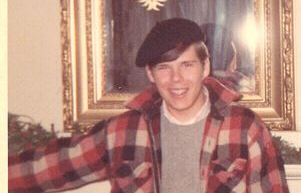
When he wasn’t navigating his way to New York and back, he had the job at Lincoln Dairy in the Center that he really liked. And the manager liked him and quickly made him assistant night manager. Not a big job or a fancy title, but it meant a lot to Page. He wasn’t doing that great in school – probably too dull for him – and he picked up a lot of hours at the Dairy.
He had enough sway so that when I turned 16 in April, I got a job there, too. When school ended, the two of us were working full time for $1.25 an hour. It’s funny to look at those paychecks. I thought I was loaded. I’d work 40 hours, which came to 50 bucks and, minus the taxes, I’d walk away with about 41 dollars.
We had a great time, the summer of 1967. But it did not last.
Categories: My story

 Alan Sivell's A Boomer Life
Good writing, I feel like I’m really getting to know your brother and wondering what he’ll do next. There is some good descriptive writing, and it’s not trite or overdone. (You’ve avoided the “it was a dark and stormy night” type of cliche.)
Keep going, I’m anxious to see what happens!
Tough decisions whether to hang with your older brother or friends. I’m guessing you had some good friends for a diversion.