At first, Doom wasn’t going to pay me anything to mow the lawn. Then he settled on 35 cents. Thus began my life of work at the age of 9. The neighbors paid more: I earned 75 cents from the Herman’s family in the house to the north and a dollar from Mr. Waters in the house to the south.
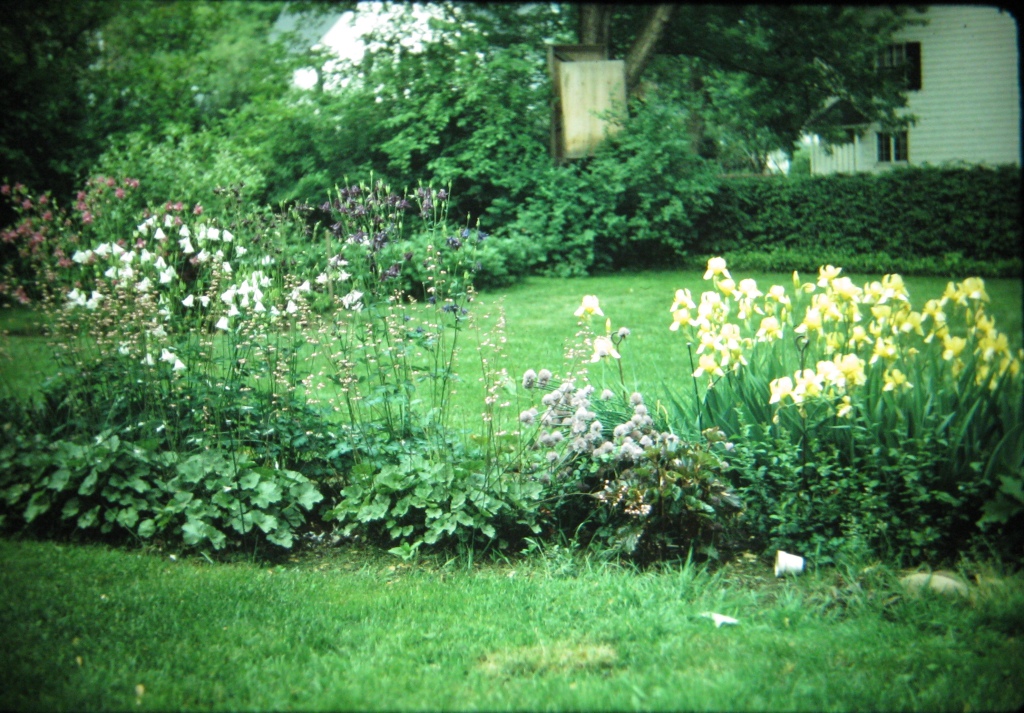
I was most enthusiastic about mowing for the Englishes, the old couple that lived on the other side of the Waters even though they had a big side yard. They paid the most, $1.25. But that was only two or three times a summer, when their lawn guy showed up too drunk to handle power equipment.
So usually I made $2.10 total, but could get it up to $3.35 in a good week. One summer I saved $12. That might not sound like much for a summer spent cutting grass, but I had expenses.
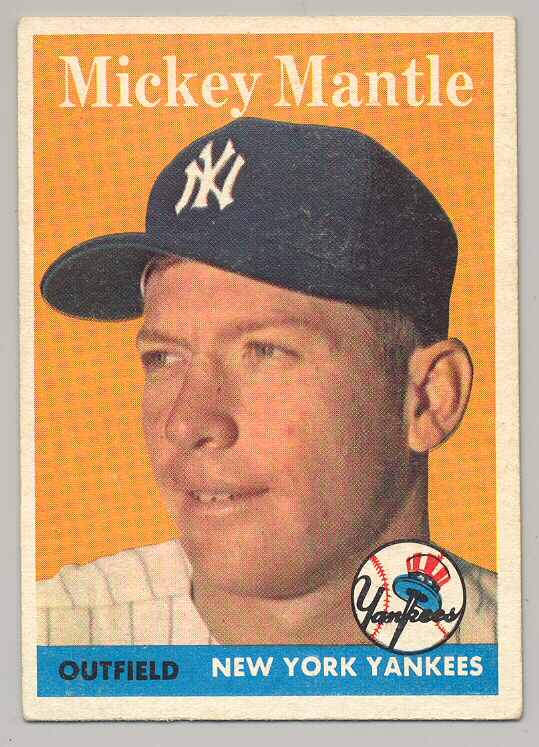
Baseball cards.

As soon as I had 25 cents in my hand, I was on my bike, headed down to Perry’s Drug Store, overseen by a very dapper man in his late 40s. Mr. Perry wore a grey smock about the same color as his hair and his Don Ameche mustache, a pencil line just above his lip. He had a great collection of comic books that he’d let you look at for a couple of minutes.
But Mr. Perry had an internal timer that would go off if you lingered too long and from across the store he’d let you know – with a tilt of his head, a raised eyebrow or a quiet clearing of his throat – that it was time to buy or go.
After I hit my time limit with the comics, I would walk very slowly past the candy, which you were not allowed to touch unless you were going to buy. Then I would get to the box of baseball cards next to the register, which brought me as close as I wanted to be to Mr. Perry.
Mr. Perry wasn’t mean, but he was not an affable guy. He probably had something more profitable to do, like compound a prescription, rather than police customers who clutched their life savings in sticky little hands.
He rarely showed any expression and when he did, it was usually one of annoyance – twitching up one side of his mouth as if he had acid indigestion – at the kids who never bought anything. He seemed to tolerate the kids who had money to spend.
I actually think he kind of liked me because, for a kid, I was a pretty regular paying customer. I always stopped reading before he had to send one of his wordless signals and I never pawed at the candy.
I would buy five 5-cent packs of Topps baseball cards, ride back up the street and sell the sticks of gum that came in them to my sister or brother for a penny apiece. Then, with those 5 pennies, I would ride the three blocks back to Perry’s and buy one more pack. With that original quarter, I was able to get 30 cents of baseball cards and still have a stick of gum for myself.
My parents were somewhat appalled that until I turned 12, I spent all that money on baseball cards. After that, I shifted my spending to records and girls. … which they didn’t view as an improvement. But by that time, I had amassed thousands of cards. Since I kept them in pretty good condition, 40 years later I was able to sell a good portion of them at an auction house for $13,000, a nice return on the original investment.
I finally got regular work – a paper route – starting in 7th grade when I was 12. I was so proud. Being a working man and having a paper route and money – the ability to buy a snack after school that meant you got a stool at the counter at Vanderbilt Drugs. I could buy my hard rolls … and spend the extra nickel for butter.
The early hours of my route were no problem. I never overslept. Early on in life, I got in the habit of getting up very early. That’s because I inexplicably loved baseball so much.
Ever since I learned to read a box score, I treated every morning between April and October as if it were Christmas morning: I’d wake up before anyone else and tiptoe downstairs, my feet reaching for the far side of each step to avoid all the creaks of the old house.
I didn’t want to wake anyone. I wanted to be the first to get the morning newspaper and specifically, the sports section.
I didn’t know it at the time, but this education on knowing where all the creaks and squeaks on the stairs were would come in handy a few years later. Again, in the early morning … when I was sneaking back into the house … after curfew.

Most mornings, until I got my route, I would be downstairs by 5 a.m. sitting on the floor in the foyer with my back against the front door. I nodded in and out of sleep, as I waited for the hollow thud of the paper when it would land on the big wooden porch. Once I was a carrier, I’d get to Mrs. Carney’s darkened garage to pick up my papers before anyone else so I could be the first one to cut the twine on the first bundle and so I had a few minutes alone to check the scores.
Getting up in non-baseball season months was a bit harder. I’d set the alarm, sometimes two, and put them on different sides of the room. It worked. I was never late. Well. Yes, there were mornings when I had to burst out of the house and bike at top speed to make up for resetting my alarms too many times, but it didn’t happen often and it was never past the Courant’s accepted delivery deadline.
I saved my money and bought a very sturdy Raleigh bike that had a big basket on either side of the rear tire. If the weekday paper was a normal size – Thursdays with all its advertising was a killer – and the weather good, I could leave my house on the bike, get to Carney’s, count the papers, fold them in thirds, stuff them into the baskets and deliver them without getting off my bike and be back in bed within an hour.
It took practice, but eventually, I could reach back into a basket, grab a paper and toss it on the porches as I rode by. It was pretty slick. I timed myself every morning, trying to beat my “world” record. I hated it when I’d miss my target and I’d have to get off the bike and put the paper where it was supposed to go: to the left side of the door if the door opened from the left and to the right of the door if it opened from the right.
If you put it directly in front of the door, when the customer opened the door, it pushed the paper away. Then the customer has to step out onto the porch to get their paper.
On Sundays, the paper was too thick and heavy so not all my papers could fit in the baskets of my bike. At first, I had to make several trips back to Mrs. Carney’s and that was not efficient. When delivering papers, you don’t want to back track. No records were set.
So my mom bought an old-fashioned baby buggy for me at a flea market. The papers stacked up nicely in it and when it rained, the hood could cover at least half of the papers. It had a spring suspension so it was easy to push and turn and a brake that allowed me to park it anywhere, even on a hill.
The other paper carriers used wagons and made fun of me for pushing the carriage. Even though we were only in 7th grade, they acted as if they were manly, using the wagons and I was a sissy for using the carriage. Sissy was easily the nicest word they used. But I didn’t care. I thought they were dopes. Especially when they rounded a corner with a full load and the tall, double stacks of papers tumbled out of their wagons. That never happened to me.
The best Sundays were when Doom would get up and drive me. We’d put the tailgate of the station wagon down and I’d sit in back with the papers, hopping off and running to several houses as Doom drove slowly down the street. When I was out of papers, I’d race back to the car for more.
A lot of parents probably wouldn’t do something like that today, but there were no cars out at that hour and I got Doom interested in setting the Sunday world record. When I did the Sunday papers by myself with the carriage, it usually took an hour and a half. But Doom and I could get the job done in under half an hour, even better than my best weekdays.
Doom thought apartments were the best things you could have on a route. You just had to walk down a hall and drop the papers. Go 20 feet and drop another instead of going house to house. Since I was making a penny and a half per daily paper and 5 cents a Sunday paper, I could make more money in less time. He got pretty upset with me when they built an apartment building at the corner of Whiting Lane and Farmington and I didn’t lobby the route manager for the building to be added to my account. He was right, but he was the salesman, not me.
In those days, most towns had at least two newspapers. We got two at home: the Courant in the morning and the Times in the afternoon. Page had a Times route for a couple of years, before he got his morning route.
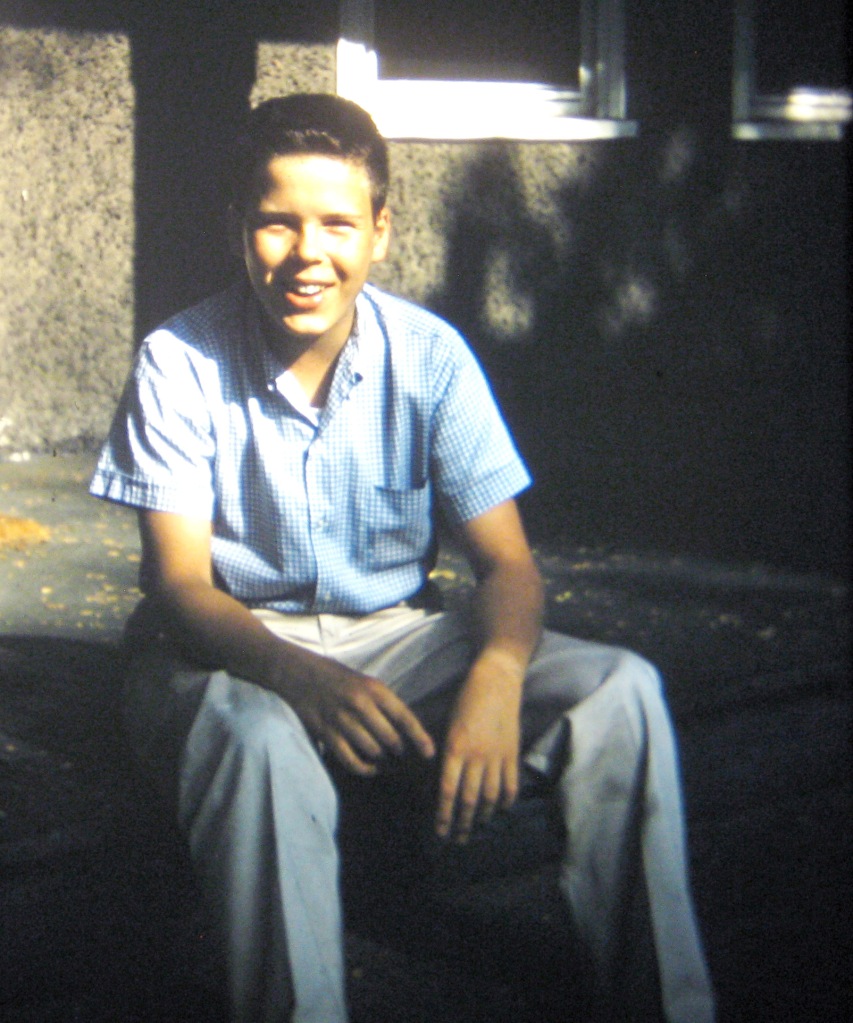
Since my route was in the morning, I’d sometimes go with Page on his route. I never wanted an afternoon route because your afternoon playtime was shortened drastically. And if you were involved in sports, you usually had to get a sub because you wouldn’t be home in time for the delivery.
Afternoon carriers often got their friends to help. Morning carriers rarely got help. Although, as we got older and realized the mischief you could get into early in the morning when no one was awake, friends would sometimes come with me to see what the world was like at that hour. And to see if someone left beer to chill on the back porch.
The worst part of the job was collecting. About half the people paid the office and that was just fine with me, although Doom said it was better if I had to collect from the people as they were more likely to tip me.
Customers paying the office got a discount and that discount came out of the paper carrier’s hide. I made a half a cent less if someone paid the office on weekday papers and a full penny less on the Sunday paper. Not a lot but it did add up to about a buck fifty a week. That’s a 15% difference considering I made 10 bucks a week.
But I didn’t really care at the time because I dreaded collecting so much. Everyone seemed surprised to see me when I appeared at their door, despite the fact that I usually did it every week on the same day at the same time … as we were instructed to. I do admit to sometimes putting it off for a week or two, until Doom pushed me out the door.
Some people would hide and refuse to answer the door. Still others would claim to have paid me the week before even though I had the stub right in the book. Luckily, I only had about 15 out of 60 customers that needed collecting.
Still, I liked the route so much because it was mine. And I was out of the house, alone, doing a job without supervision. The early morning quiet made you feel as if you were the only person alive in the world. Yes, there were the milkmen, stopping intermittently on each block and running to the houses with their wire baskets of clinking bottles full of milk and cream and rushing back to the truck with the empties. But they were in a bigger hurry than I was and were soon gone.
I felt as if I were in charge of my corner of the world, my paper route on Whiting Lane and Plymouth and Forest Roads.
Sometimes, during the summer, I liked to walk and listen to my radio. I had a transistor radio – the iPod of its day – that fit in my shirt pocket. I’d plug in an earpiece and listen to my favorite songs on the top 40 while tossing papers. Hot time, summer in the city. 1965.

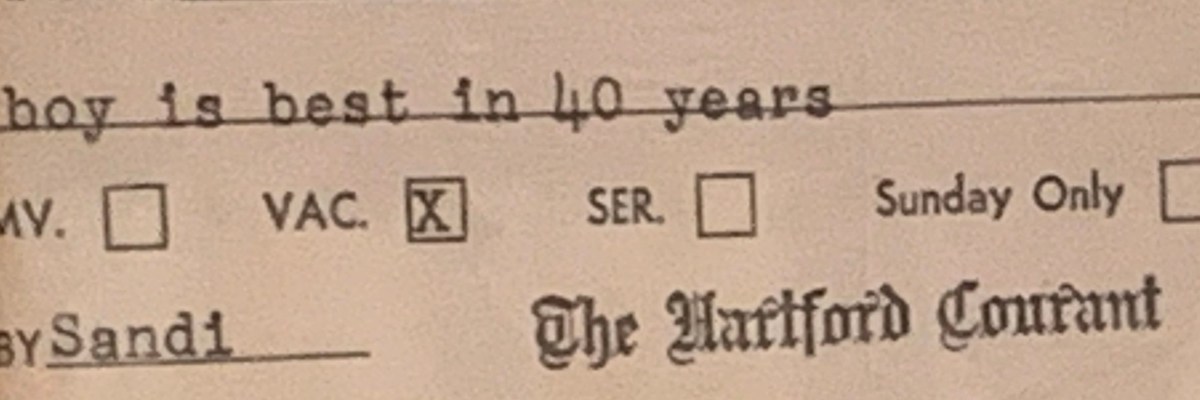
I was pretty good at the job, getting the paper there even earlier than the people expected it and putting it exactly where they wanted it. In fact, when Mr. Peterson at 115 Whiting Lane stopped the paper for his two-week vacation one summer, he told the route manager what a great job I was doing. When I got the stop order the next day on a thin, pink, 3 X 5 inch sheet of carbon paper, it read, “Boy is best in 40 years.”
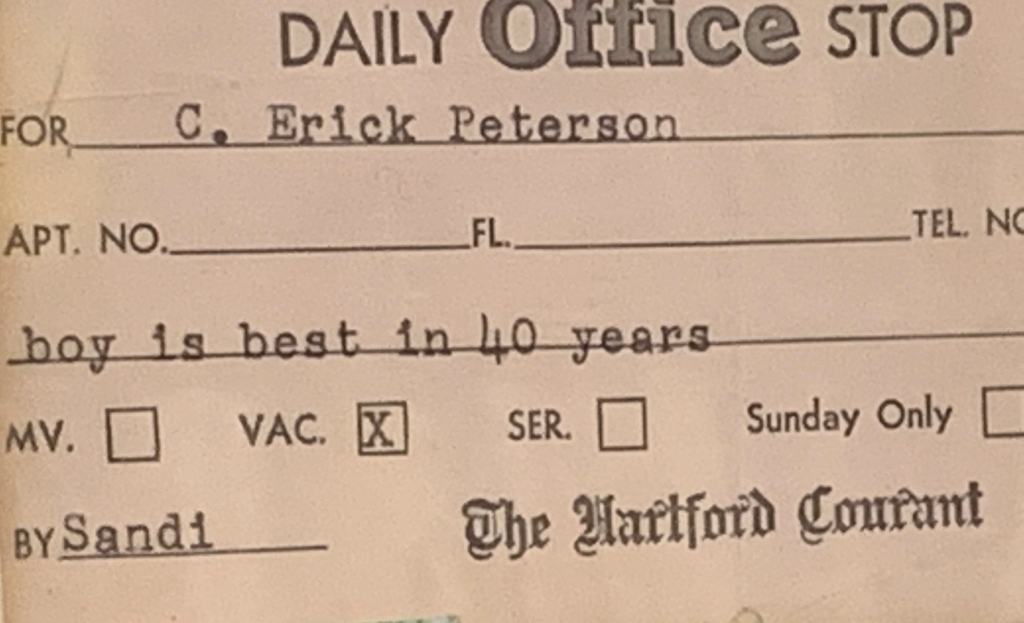
My mother framed it. It hangs on the wall of my office today. My first success in the business of journalism.
Most customers were indifferent and didn’t realize they were being served by one of the greatest carriers the American newspaper industry had ever known. But some were nice and would ask me about school when I came collecting or they gave me a cookie. There was the retired teacher who took such a shine to me she hired me to do odd jobs around her house on weekends and during the summer.
In warm weather, as I approached the house near the end of Whiting Lane on the high side of the street, I could hear the rhythmic, mechanical wheezing of an iron lung machine. The lady who lived there had contracted polio years earlier. Then in her 30s, she still lived with her parents and in the days before central air conditioning was commonplace, they would move the machine to the front room with all the windows open during the summer so she could catch a breeze. I couldn’t wait for the sound to fade as I quickly moved on to the next house.
And there was the dentist who committed suicide. They discovered his body while I was on my route. I didn’t know what was going on at the time, but there was a crowd of neighbors gawking and a lot of people running in and out of the house. Nobody noticed me as I snuck up to the porch, tossed the paper to the side so no one would trip over it and ran on to the next house.
My mom saw his obit in the paper the next day. When I went to collect a few weeks later – I put it off as long as I could – I was told they would no longer be getting the paper.
I loved that house on Plymouth Road, the last house on my route, where, when I leaned onto the porch to drop the paper in the right spot, I had to pass through an arbor that was overgrown with the intoxicating smell of lilacs. If I were early enough and I was sure that no one was up and I wouldn’t be seen, I’d grab a sprig to inhale on my way home. It overpowered the smell of the newsprint, which by that point of the day, I was sick of. It had blackened my hands, my clothes and my face when I wiped my brow.
Toward the end of my delivery time, as it neared 6 a.m., people started to get up and I’d see them moving about in their bathrobes through their window. Traffic was increasing. Cars no longer needed their headlights. I knew then my time was done, like Cinderella, and others were taking over the day. Suddenly exhausted, all I wanted to do was get home, crawl back into my bed for a last half hour of sleep and gather my strength for my next challenge: the school day.
Next Week: Chapter 9: The Real Doom
Categories: My story

 Alan Sivell's A Boomer Life
Your narrative brings back lots of similar memories for me. I had an afternoon route though and we were required to put the paper between the storm door and the actual front door. Because of that I usually walked the route. But almost every house took the Waterloo Courier, so it was a compact route. I also hated collecting for the same reasons as you. One woman in particular was so mean that my Dad finally went along when I collected.
My money was often spent on baseball cards as well, but I don’t know what happened to them. My team was the Milwaukee Braves (for those who are uninformed, the Braves played in Milwaukee from 1953 until about 1965.) I still haven’t forgiven them for moving to Atlanta.
My second favorite team in those days was Milwaukee … even though they beat us in 57. Aaron, Adcock, Mathews, Spahn. Burdette (former Yankee prospect), Crandall etc. What a great team. I also liked their hats.
Good memory! I actually saw all those players. My grandparents lived in Milwaukee and my grandfather took me to several games every summer.
BTW, your team was always referred to as the “Hated Yankees,” not just the Yankees. The traditional story (true or not) was that upon arriving in Milwaukee one of the Yankees called it a “bush” city. Braves fans had a long memory about that comment 😀.