
You’d think there’d be no inheritance from an 18-year-old kid who was an assistant night manager, making barely above minimum wage. However, I knew Page had left something behind. But I wasn’t sure how to break it to my parents.
I had figured it out a few months before when, one day, Page left for work and didn’t walk up the street to catch the regular bus on Farmington Avenue. Instead he walked down the street, toward the Boulevard. He later told me that he liked the busses on the Boulevard better. I didn’t believe him because that was a nonsensical lie. So a few days later, I followed him down the street and continued following him as he walked away from the bus stop.
He glanced back occasionally and I thought I was successfully darting behind trees, just before he could fully turn around and see me. But that only lasted a block or two.
“C’mon, Bonzo,” he called out his “pet” name for me, the name Doom affectionately took over after Page died and called me for the rest of his life. “I know you’re there.”
I didn’t move, hoping he was bluffing.
“C’mon,” he insisted. “You were probably going to find out eventually. And I don’t want to be late for work.”
I came out from behind the tree and jogged up to him.
“I’m going to show you something, but you can’t tell Mom or Doom,” he warned. “Or I’ll have to pound you.”
We walked another block to a triplex on Prospect Avenue and walked up the driveway to the four car garage. Page fished a key out of his pocket and opened one of the doors. There was a 1962 Honda 305 Dream.
Page left a motorcycle. And a garage lease.
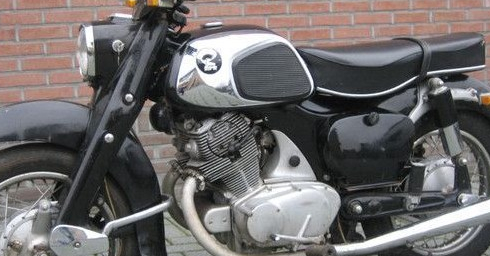
My parents had no idea that he had it. Since he had no license and wasn’t about to get one in the foreseeable future, he didn’t park it at home. I didn’t know how to break it to my parents after he died so I paid the rent and kept the secret for a few months. I actually thought it would be kind of cool to have my car and a motorcycle. Even if I had never ridden one.
One Sunday morning that fall, I got up early and went down to get the motorcycle out of the garage. I figured with the light traffic on the road on that day and at that time, it would be the perfect time to teach myself to ride the bike.
But … I didn’t realize how heavy it was, how hard it was to start and how many things I had to be simultaneously conscious of: shifting, breaking, safety. I struggled to keep it upright as I started it and barely made it out of the driveway when I decided to turn around, park it and tell my parents about our inheritance.
Within a week, I sold it to a kid at school.
After the funeral, I thought I could just get on with life, as if Page’s death was simply a routine life event. Like being late for class, getting a flat tire, or having your morning newspaper land in a puddle. I tried to make Page’s death an aggravation, something in life that just needed to be dealt with.
I wasn’t successful, but I didn’t know it.
I didn’t realize how much it was affecting me until one day in late October, about two months after the funeral. It was near the end of football practice and I had just messed up on a play as the third stringers ran their reps well after the 1st and 2nd teams moved on to other drills.
The lights over at the town hall were on as the sun had long since slipped behind the buildings in the Center. I squinted at the clock tower to see how much longer this drudgery would go on.
I had no passion for the game and even less after the funeral and because of that, couldn’t make up for the fact that I was slow, legally blind without my glasses and never studied the playbook. So I never knew what I was supposed to do on a particular play and therefore was often out of position. And I didn’t like to hit or get hit.
The good thing was I was third string. The only way I was getting into a game was if a building collapsed on the team. So it didn’t really matter how bad I was. Nobody cared.
Or so I thought.
Just as the town clock was coming in to focus with my squinting, I suddenly saw a handful of fingers shoot through my facemask, invading the sanctuary of my helmet. I was trying to focus on what turned out to be the back of some very hairy knuckles as my head slammed side to side inside my helmet.
The knuckles belonged to Mr. Chalmers – Chomps, we called him – the assistant head coach. He held on to my facemask and kept jerking my head back and forth and side to side while screaming at me.
“Wake up! Wake up! What is the matter with you? What are you thinking?” Despite the rattling of my head and my brain, I could see foam coming out of coach’s mouth. He wasn’t merely setting an example with me. He was seriously pissed. “You are in a daze out there!”
I don’t think either he or I realized how deep of a daze I was in. But there was something about being noticed that got to me. I was just a body filling a hole – I would have been fourth string if we had a fourth string – and there should have been no reason to notice me. Unless I was really screwing up.
When Chomps was done throttling me, I was even less into practice than before. But I didn’t want my head rattled again, so I pretended I was fired up and I hit a couple of people harder –as hard as I could – but on the walk home my mind was racing: What had I looked like to other people – at practice and at school? What had my reactions been like? Thinking – over thinking, actually – was another one of my problems at that stage. I acted like a chess player, thinking and not reacting.
Maybe Page’s death had affected me more than I knew. Maybe I was internalizing my grief. To other people it must have been obvious. Not to me. I thought I was doing fine.
I was enjoying school, although that was because I had a girlfriend and car. At 16, what else could one possibly need? But Mr. Chalmers saw something else. So did my teachers and so did Dr. Dunn, the principal.
A couple of days after the incident on the football field, I got called down to the office. I’d been there once or twice but not for anything bad since the 8th grade when Mr. Harmon stepped on my bologna sandwich trying to stop a melee in the school cafeteria and I gave him a shove. And the time before that when the Whiting Lane gym teacher called a race the wrong way in 4th grade and I disagreed. A bit too vehemently. But, after all, it was the big race at the end of the school year field day.
I had no idea why I was going to the principal’s office this time. When I got there, Dr. Dunn said he just wanted to talk. He wanted to know how I was and let me know that people in the school cared about me. I didn’t think about it at the time, but it could have been an exercise out of a teacher training manual that says a month or two after a sibling’s death, call the student in and ask them how they are doing. If that’s what it takes, great. Because it worked for me. It let me know that adults who were not my parents did notice me. They did care. I had to get it together because people were watching me and expecting things from me.
After that, I got more involved in school. I’d like to say that I studied harder and took my classes seriously. But that didn’t happen. I opened the books only when necessary and managed to hand in most assignments on time. But they weren’t done well or very thoroughly. When I came to a difficult math problem or a study question that required a more in depth answer, I skipped those and told the teacher that I didn’t get them.
At home, I was too busy reading what I wanted to read or listening to the AM DJs send out requests. I was too into the social life.
That’s what I threw myself into, being Mr. Social. The “hub of the action,” the yearbook says. I knew what social event was going on and where and who was going and with whom. I got on a bunch of school committees. I knew just about everyone in the school and they knew me.
Bethani was working at retail store in the Center, just about a block and a half away from The Dairy and we were still in the first blush of the romance, bonded even tighter because of the events with my brother. We tried to co-ordinate our breaks. She would come up on her 15 minutes of freedom even though it meant – with travel time – she got to sit at the end of the counter with me for 5 minutes. Sometimes she would stay 7 minutes but then had to run back to her store.
We always went to the weekly town dances, at the school or the Y. It was nice to have someone to go with. In years past, my only companion was the fear of rejection. I would spend the entire night worrying about asking someone to dance – while trying to pretend I wasn’t. And if the worst didn’t happen – rejection – then surely the next to worst would – acceptance – and I’d be committed to that person for the night, year, and probably forever.
We’d go to movies and parties, although I don’t remember too many of them that year. We’d finish up the night by stopping at the overflow parking lot at Fern Park, which, unlike the main lot, was not lit. We’d kiss for hours, until the insides of our mouths were sore. Occasionally the cops would come by and shine their six D-cell flashlights into the car. Of course they would ask what we were doing. I had to suppress screaming, “What do you think we’re doing?” Or, “Get some new material, flat foot.”
The cops in that town seemed to know exactly where every kid had pulled over to make out. And it was their mission to put an end to any pleasure any of us might be having.
There really was nowhere to go to be alone in those days. If you went to your girl friend’s house to watch TV, there was only one and it was in living room. Her mom would have enough sense to be sewing a room or two away, although always within earshot. If that were the only parental watch dog, you could at least have a nice night of stealing kisses.
But the dad was usually in the living room with you, too, and so were all the little brothers and sisters. Under those circumstances, the best you could hope for was to sit close. If you did try to sneak a kiss while the dad went to the bathroom or the kitchen for a snack, the younger siblings would loudly announce it.
The girl’s parents watched how you reacted to the brothers and sisters to see if you were a good guy. I was a good guy, but in those days, at the age, I wasn’t interested in making nice with the little brothers and sisters. I was interested in making out.
So TV at the girl’s house was a last resort. And boys did not bring girls to their house. It simply wasn’t done. Unless your parents weren’t home.
Once we drove to a dance club in Manchester with my best friend, Bob, and his girlfriend, Becky. Bethani’s parents didn’t know about it. They reluctantly let her drive with me, but only in town. Looking back, I can’t blame them. I was 16 and had just gotten my license. But there was no dance in town that week and we wanted to dance so we went to the club. We had a great time and I can’t believe her parents didn’t know as she got more dressed up for that than she usually got for town dances. I still remember that she wore a white dress with red polka dots that night.
Christmas, though, was the beginning of the end of our relationship. I knew Bethani wanted a bangle bracelet. But I was still a kid, not a mature romantic. When I got the bracelet, I put it inside a catcher’s mitt and wrapped that. So when she opened the present, she thought it was a glove she was getting. It took the edge off the romance all right. Even when she saw the bracelet, she was pretty mad and embarrassed, since we exchanged presents at her house, with her parents there.
I still do stuff like that. I don’t know why. Maybe I will never grow into that mature romantic. But at least after Bethani, I was with someone who – if she didn’t appreciate that side of me – or at least tolerated it and didn’t make me hear about it for days, weeks. And appreciated the thought behind the gifts. Bethani gave me a silver ring with a black “stone.” I was already wearing my mom’s high school ring and my dad’s college ring. How many more rings could I wear? It was unusual for a kid that age to be wearing that many rings. But I began wearing it. And I still have it.
We kept on dating through Christmas, but after the first of the year, we were arguing all the time. It wasn’t fun like it had been. Whatever I said was wrong. I wasn’t deep enough. I wasn’t serious enough. This was a girl who studied every moment she wasn’t in school or talking to me. She was locked in a to-the-death struggle with Marilyn Ducette, the school’s other genius, for school valedictorian. And there was still a year and a half to go in that battle.
I, on the other hand, studied only when I had to and often times, not even then. I had Bethani, work, sports, my friends and my car. School was near the bottom of the list. I don’t think that bothered her, but my light approach to everything did.
She said I was shallow.
Let’s face it. She was a very serious person and 1968 was a very serious year with the Vietnam War intensifying with the secret bombings of Cambodia and the assassinations of Dr. King and Robert Kennedy. But I felt it was my job in my circle of friends to put a light touch on things, to make the wise crack or put the ironic twist on the craziness of life.
She wanted someone deeper. Today I like to think I combine both. But she wasn’t going to wait 30 days, let alone 30 years. So we broke up.
Which was great for a while. I felt free. I didn’t have to wait for her to finish studying in the library and take her home after school. I didn’t have to call her at precisely 9 o’clock and talk for 15 minutes when there was nothing to say (those calls were just an argument waiting to happen) and I was free to talk to other girls. It is amazing that when you are going out with someone, there are always so many more girls attracted to you and you to them. Maybe you seem more attractive because someone else finds you attractive. She had elevated my status. I was datable material.
But the junior prom was coming up. That was the big social event of the spring semester. You had to go and you had to go with someone that didn’t make you look desperate, like a friend or neighbor or worse – a relative. This wasn’t a throw-away date. I liked a bunch of other girls, but none that I wanted to commit to. And if you asked a girl to the junior prom, that was almost like getting engaged, at least high school engaged. You were obligated to take her out again. And probably date her for the rest of the year, an eternity at age 17.
When the school year ended, you could always stop seeing each other because summer caused a lot of break ups. That was natural. Just pour yourself into work and stop calling. When you get back in the fall, you just look the other way the first few times you see each other in the halls and within a few weeks, it’s as if you never went out.
So it would be a lot easier to go to the prom with someone where you knew the situation. And for me, that was with Bethani. The problem was, a couple of my close friends liked her and had wanted us to break up so they could date her. Steve Church and Sam Bellow.
I didn’t worry at all about Bob even though girls were and still are Bob’s main preoccupation. Bob had been friends with her because of the summers they spent at Fern Park as kids. He thought she was cute. But Bob and I were best friends and there was a code – you don’t date the other guy’s girl. Even after they break up. It just wasn’t done. That worked pretty easily for me, because despite the astounding numbers of Bob’s girl friends. There were never any that interested me.
Then I started to hear that Steve and Sam were interested in asking Bethani to the prom. Sam seemed to be the big rival. He was serious, smart, played an instrument and could be very dark and brooding. Bethani liked dark and brooding.
I started to panic. I wasn’t dating anyone else. I couldn’t remember the fights. I could only remember how cute she was and how smart she was. And how much fun it was to smooch in the darkest corner of the overflow parking lot at Fern Park. I began to think that I should make up with her and ask her to the prom.
Although, when you are 17 and you break up because of all the fighting, you should stay broken up. It’s part of the growth process. Oh, sure, everything seems great when you get back together, but within days or weeks, the old patterns come back. You aren’t capable of mature change at that age. It’s just too hard trying to grow up and find out who you are while at the same time trying to mold yourself into someone your partner wants you to be. There are a lot of hormones and not a lot of smarts.
But I didn’t have that wisdom then. So I started to make a plan. The ski trip was coming up.
Next week: Chapter 15: Cold … and Calculated
Categories: My story

 Alan Sivell's A Boomer Life
I’m shocked at how similar we were in high school and 30 years apart… the part describing how you viewed your academics vs your social life could’ve been written by ME about me!
Well, when you gave that first speech freshman year about your baseball experiences, I felt the same way. In reverse, of course.