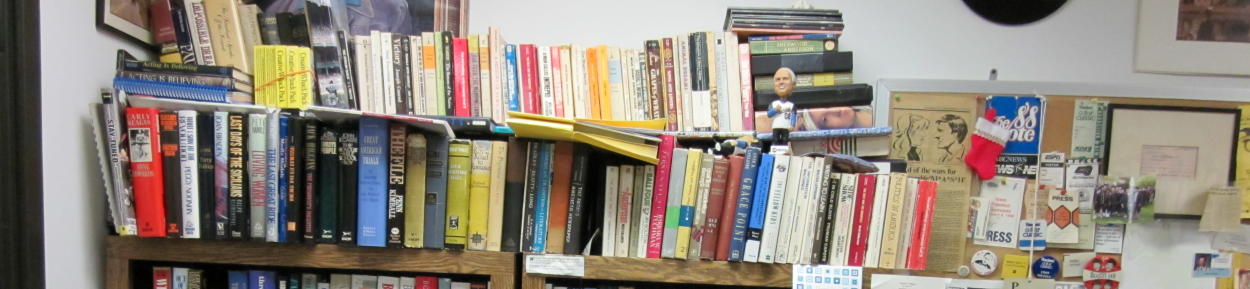
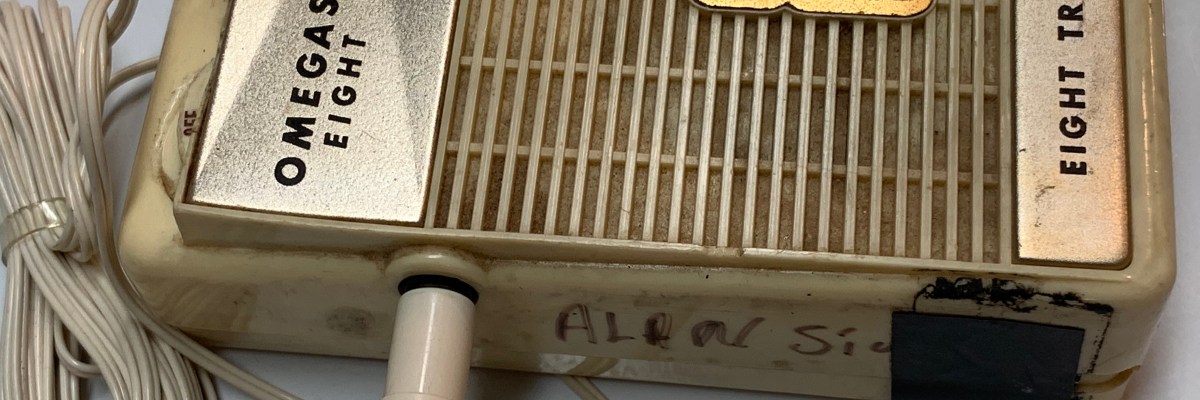
As a kid, I dreamed of getting a magic lantern and rubbing it to awaken the genie who could grant my wishes. Not surprisingly, I never got that magic lantern. But when I was 10, I got a magic box. It didn’t come cheap. It cost $10.
I earned the money mowing lawns. I got 35 cents reluctantly from Doom for our house, 50¢ from the next-door neighbors and $1.25 from the folks with the double lot two doors down when their lawn man didn’t show up after a night of drinking. Which happened fairly frequently.
When I finally had the $10 – which took all summer because I kept spending down my cache buying baseball cards at Perry’s drug store – I took the bus to the E.J. Korvette discount store in downtown Hartford and bought my box – an eight-transistor radio, a little block of plastic not much bigger than a deck of cards. It was made in Japan, which Doom didn’t think much of. He had spent his time in World War II on a ship in the Pacific. But I loved it.

It was my window to the world, expanding the universe beyond my bedroom on Beverly Road in West Hartford, Connecticut to baseball stadiums and rock and roll stations all over the country. I may have been part of the TV generation, but my transistor radio was as important to me then as a cellphone is to a kid today.
With a bedtime that started before the games on the west coast did, I happily crawled into bed clutching my prized possession and, staying up past midnight, listened as the Yankees played the California Angels.
I listened to the wit and wisdom of the disc jockeys who alerted the country to the rock and roll music that was bursting on the scene. On week nights, I tuned into the local stations. But on Sunday nights, as the country quieted down and there was less electronic interference, radio signals from stations like WOWO-AM in Indianapolis and WBT-AM in Charlotte, North Carolina clearly beamed into my third floor bedroom.
Eventually, I also listened to the news. Because of the federal regulations at the time, even the rock stations were obligated to keep the country informed. Every hour at the top and bottom of the hour, the stations’ newsmen – and they were only men – droned on about local and world events, sports and the weather for five full minutes. As a teenager waiting for a favorite song to be played, it was a very long five minutes.
I wasn’t happy about hearing the news at first, but because I had to, I began to learn about the war in Southeast Asia, the ongoing troubles in the Middle East and the political unrest in America that led to riots and the assassinations of our next generation of leaders. Just as I had favorite disk jockeys, I began to have favorite newsmen. They seemed almost as cool as the DJs.
After dinner, my big sister washed the dishes and I dried. It was the only time of day when we were allowed to change stations on Mom’s kitchen radio. We’d tune in to the daily countdown of the top ten hits between 6 and 7 p.m., hoping that our favorite songs, like Runaway by Del Shannon, would make it to the top.
Later, if the Yankees were on, Doom would set a small Emerson plug-in radio facing out of the living room window and we’d sit on the front porch to listen while cooling off on hot summer nights.
My world was no longer limited to the area between my house and my school three blocks to the west or the city park four blocks to the north.
When my 10th grade speech teacher, Harold Riemer, told me my voice was a gift and predicted that one day I’d be on the radio, I was thrilled. It was something I had been dreaming about but had never told anyone. I didn’t think it was possible. Mr. Riemer thought differently.
But then Mr. Riemer’s and his encouragement were suddenly gone. When we came back from Christmas break sophomore year, there was a long-term sub in his place. No one told us why he left in the middle of the school year. With the sub – who was a brand new teacher – I was just another student in a class of students he would spend the semester trying to control but never get to know.
Without Mr. Riemer, my focus turned from a future in radio to his other, slightly more achievable and much more immediate goal for me: pairing up with Bethani. She became the passion of my life (as did Sam the next year) and a career in radio dropped down my list of interests.
I forgot about thinking of my future or nurturing my “gift.”
That neglect continued the first few years of college, too. Northeastern was such a big school, I was just trying to find my place in my wing of the dorm. I didn’t even think of going to look for the school radio station. It wasn’t until I transferred schools that the light came back on for radio.
WWHS-FM, the campus station wasn’t on the air yet when I got to Hampden-Sydney. A group of guys had formed a radio club a few years before and were working on it. The station was scheduled to sign on within the year. Like the baseball team, the radio station welcomed anyone who showed up.
The guys who built and wired the station and went through the licensing process seemed more interested in the behind the scenes aspects of the business. They were happy to find those of us who were more interested in the performance side.
They had titles like station manager and operations manager. I gave myself the job of record reviewer. Record companies sent us hundreds of records and they needed to be listened to before we went on the air. I also signed up for a three-hour shift on Sunday nights, playing oldies, when we finally went on the air.
But there was a catch.
Once we went on the air, someone with a broadcast license needed to be in the station. Since I didn’t have a license, I always had to have one of the few licensed guys in the station with me when doing my show. I didn’t like having a minder. I was determined to get my broadcast license.
The test for the federal 3rd class radio license was only offered a few times a year and in specific locations, kind of like the college entrance exams. The first available date that fall was in November, at the federal building in Norfolk, Virginia. A van load of the station’s prospective on-air talent signed up to make the three-hour drive for the test.
At first, I didn’t take studying for the test seriously. I figured it was going to be like a driver’s license test. Heck, everybody passes those. But the club leaders kept telling us that this test was much harder.
Some of them, who were some of the top students at the school, had failed the first time through. This was a federal test. Of course it would be tougher.
Since I wanted to prove myself to the officers of the club that I was serious about radio, I began studying more for that test than I did for my academic courses. And the guys were right. The test was hard. My chance for passing it came down to correctly answering the one, multiple choice question I had skipped earlier and saved for last.
The question was about the placement of the meters on a transmitter in a one person/small station. Did they need to be visible from the on-air booth? I sweated over that question for the final 5 minutes of the timed test until it dawned on me that I could see them at our radio station when I was in the announcer’s booth. So I figured, yes, they had to be visible. Just before the timer went off, ending the test, that’s what I answered. And I was one of two in our group who got their license that day.
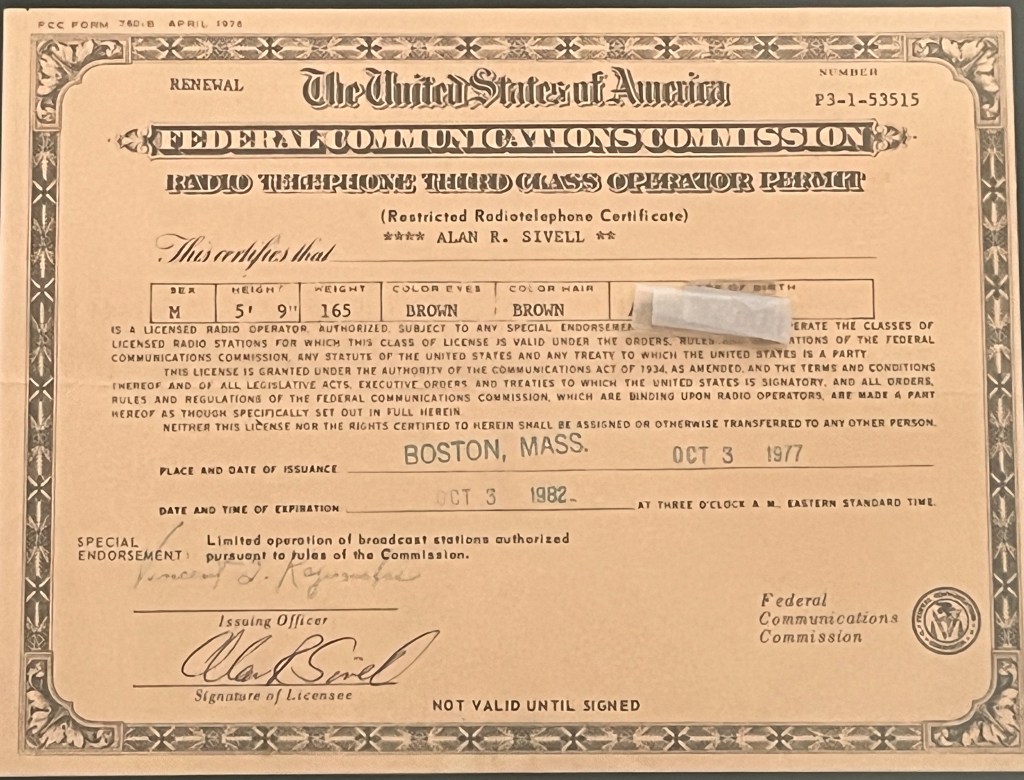
The long ride home after that test was much better than any of the bus rides home after winning a football game in high school. Those had been fun. But since I spent most of my time on the sidelines, I rarely had anything to with the game, let alone a victory. Here, I was now in the upper echelon of the radio station at Hampden-Sydney College. I had done what two thirds of the other guys in that van couldn’t do.
I could now do my show on Sunday nights solo. In those days, most radio personalities had on-air personnas so rather than go on the air as Alan Sivell, I needed to become someone else. The previous summer I had worked on a golf course with a colorful named Ezra Goupee. I had never known an Ezra before and was only faintly aware that Ezra was a biblical name. I just figured the name would be unique. So I became “Ezra,” host of “The Ezra Show.”
I would get a couple of friends to help lug boxes and boxes of my LPs from our house 50 yards across the parking lot to Winston Hall, then upstairs to the station. I had so many records that even with the help, we’d often have to make two trips. I also brought 45s, which weren’t as heavy, but still, it meant more boxes to carry. I wanted every record I owned with me. I never wanted to be inspired to play a song and then not have it.
My collection of 45s had started when I was in second grade. I loved “Charlie Brown” by the Coasters and Mom bought it for me. I loved it so much, I brought it to school for show and tell. That a sixth grader sat on it and cracked it on the bus ride home didn’t deter me. I was hooked on records.
By the time of my radio show, I had hundreds of 45s and a few dozen albums filled with oldies from the 50s and 60s that I kept buying (a pattern that would continue well into my adult life). I’d get everything ready at the station and then, with five minutes to go before air time, I’d run back to the dorm and set up an 8-track recorder to capture the show for posterity. And so I could relisten to the shows as I drove around on the 8-track in my car.
Even though my memory tells me – as do my friends at reunions – that I produced an entertaining show, the tapes reveal someone so amateurish and unsure of himself, they are embarrassing to listen to today. That’s because the tapes reveal the hard truth. They don’t soften as a memory might.
The entire audience of the show consisted of probably 10 people at most – all my friends. But these friends acted as if I were a famous local personality and treated me as such. They were disbelieving when we were at parties or at a bar in town if someone said they didn’t know who Ezra was. Or that they had never heard of The Ezra Show. It was perfectly understandable to me in that it was a 10 watt station that barely made it across campus, but to the guys who gathered back in the dorm every Sunday night to smoke dope and listen to me, I was a star. And everyone should know it.
In addition to my show, I also had the job of reviewing the stacks of albums the record companies were sending to the station now we were on the air. I was having trouble keeping up but I figured I’d have plenty of time to tackle them over Thanksgiving weekend.
I was going to stay on campus because driving 550 miles to Connecticut and then another 550 miles back seemed like too much driving for a four-day weekend.
By mid-afternoon Wednesday, the campus was deserted. So I headed over to the radio station where I had a KEY!!! And let myself in to be surrounded by hundreds of brand new albums. For someone like me, who has had a lifetime addiction to vinyl records, it was intoxicating.
I took a couple of deep breaths to drink in the pleasure of my situation and got to work. I was making my way through a stack of artists I’d never heard of when an intriguing album cover caught my eye so I decided to give it a spin.
The first song sounded OK. The next song sounded OK and the third song was OK. I started to skip around on the record and to my untrained ear, they all seemed to sound the same. Just OK. So I put it in the Do Not Play pile and forgot about it.
The next day I went to Harvey’s house for Thanksgiving and the day after that, I met Mom and Doom in Atlantic City where we watched Hampden-Sydney play in the Knute Rockne Bowl for the Division II Eastern Championship. Doom had been a captain on the 1942 team and he wasn’t going to miss the game. Unfortunately, Hampden-Sydney lost, 17-12, to Bridgeport.
When I got back to campus, I stopped by the radio station and one of the especially nerdy freshman had some music playing and it sounded great.
“What album are you listening to?” I asked.
“It’s a new group,” he said. “Steely Dan.”
He showed me the cover. It was “Can’t Buy a Thrill,” the album with the interesting cover and the songs that had all sounded similar and just OK to me. The album I had dismissed just a few days before.
Apparently, I needed to re-evaluate.
By the middle of the next week, it was my album of the moment. “Reeling in the Years” helped my typing speed enormously. It had just the right tempo for pounding out 10-15 page term papers.
I typed standing up with my little Smith-Corona on top of my dresser as I’d read that’s the way Hemingway wrote. This worked out great because standing gave me more energy to type and I could easily walk over to the turntable and start the record over and get right back to my typing.
Steely Dan made a lot of other very good albums. And yes, they sound similar, not alike, because, like a lot of artists, Steely Dan has its own “sound.”
The lesson I learned from my Steely Dan debacle was to try to have second thoughts – however fleeting – about everything. And that included The Ezra Show.
I still looked forward to going on-air every week, but after weeks of sitting in the studio alone, spinning records and trying to think of something to say in between records to an audience I couldn’t see and often doubted even existed, I began to run out of the energy needed to put on a good three hour show.

A new sound effects machine installed at the station inspired me to switch things up. Especially motivating was the echo function. It gave me the idea to put on special concerts each week, with me serving as the emcee, speaking to the multitudes. With a bit of electronic fiddling, I was able to make it sound as if I were standing on stage in front of a crowd the size of Woodstock. Each week, I hosted “live” a different group or artist: the Beatles, The Beach Boys, Bobby Vee and others made appearances on “The Ezra Show.”
Of course the real stars weren’t going to come to the 2nd floor of Winston Hall on the campus of Hampden-Sydney College on a Sunday night. Rather, I enlisted my friends to play the parts of John, Paul, Ringo, Brian Wilson, etc. and I wrote scripts for each show, loaded with facts and tidbits about the artists. I gave my pals the answers to the questions I would ask, but they invariably would lose their place in the script or not be able to read my handwriting even if they were paying attention.
Despite my best intentions, it didn’t take long before each show dissolved into a lot of insider hysteria, which surely left the audience – if there was one – wondering what the hell was going on. It didn’t help that most of my actors playing The Beatles had southern accents and seemed determined to prove they were not actors.
Still, I fulfilled the promise Mr. Riemer had predicted for me: I made it on the radio. And I learned how hard doing radio is. There is way more to it than just playing records and talking. For as glib as I thought I was in my everyday life, something about sitting alone in a studio with an open mic seemed to throttle down that glibness.
But just as my enthusiasm for a career in radio was flagging, the announcement for the spring concert pumped new life into the campus music scene. However, the headliner turned out not to be the headliner.
Next time: I See Bruce and Meet Linda
Categories: My story

 Alan Sivell's A Boomer Life
Thanks !!!! Looking forward reading it !!! Since I know he’s enjoyed reading them, I ccd Bob Grillo this one ! See you soon. Please excuse typosBrad Collinsbjc6651@gmail.comCELL 860 930 1922
Really enjoyed this Chapter. Made me remember why I
just read this one. Great. I’m a huge music guy ……Can’t Buy A Thrill is a phenomenal album. Maybe their best ever ……up there with the best albums they did. Donald Fagen a genius. Love Steely Dan. I have a 30 song playlist of only the best that they did over the years.
Run run run Runaway……by Del Shannon a classic in 1961 , I think , along with his other huge hit…….Little Town Flirt and next, Hats off to Larry ………on to # 37
This chapter reminds me of my experience, it was very similar to yours. When I was a high school senior, I took a radio production course. I needed an elective credit and the class sounded like fun. During the course, we went to Des Moines to take the test for our third class license. I passed on the first try, our instructor was an old radio guy and prepared us for the test. When I went to Wartburg, I volunteered to work on the campus radio station. It was a 10-watter and barely covered the city of Waverly. I started by DJ’ing, and also helped the news director to cover stories. I had a ball running around with the small reel to reel recorder the station owned and doing news interviews. That’s when I knew I didn’t want to major in social work (which my mother had suggested). I transferred after my sophomore year at Wartburg to Iowa State where I majored in journalism with an emphasis in broadcasting.